
Can we simulate the world?
A group from Harvard and MIT are trying

Today’s paper: MatrAIx: Simulating the World with 8.3 Billion Persona Agents. Li et al. Link: https://arxiv.org/abs/2608.04205. August 4, 2026.
One of the more ambitious ideas in AI evaluation right now is that instead of waiting for costly human studies, we might build large populations of simulated users and test products on them first. That is the premise of today’s paper. The paper is not really claiming to have recreated humanity in silico. Its more practical claim is that product teams need something between toy benchmarks and real-world deployment: a structured way to stress-test AI systems against diverse user types before those systems reach actual people.
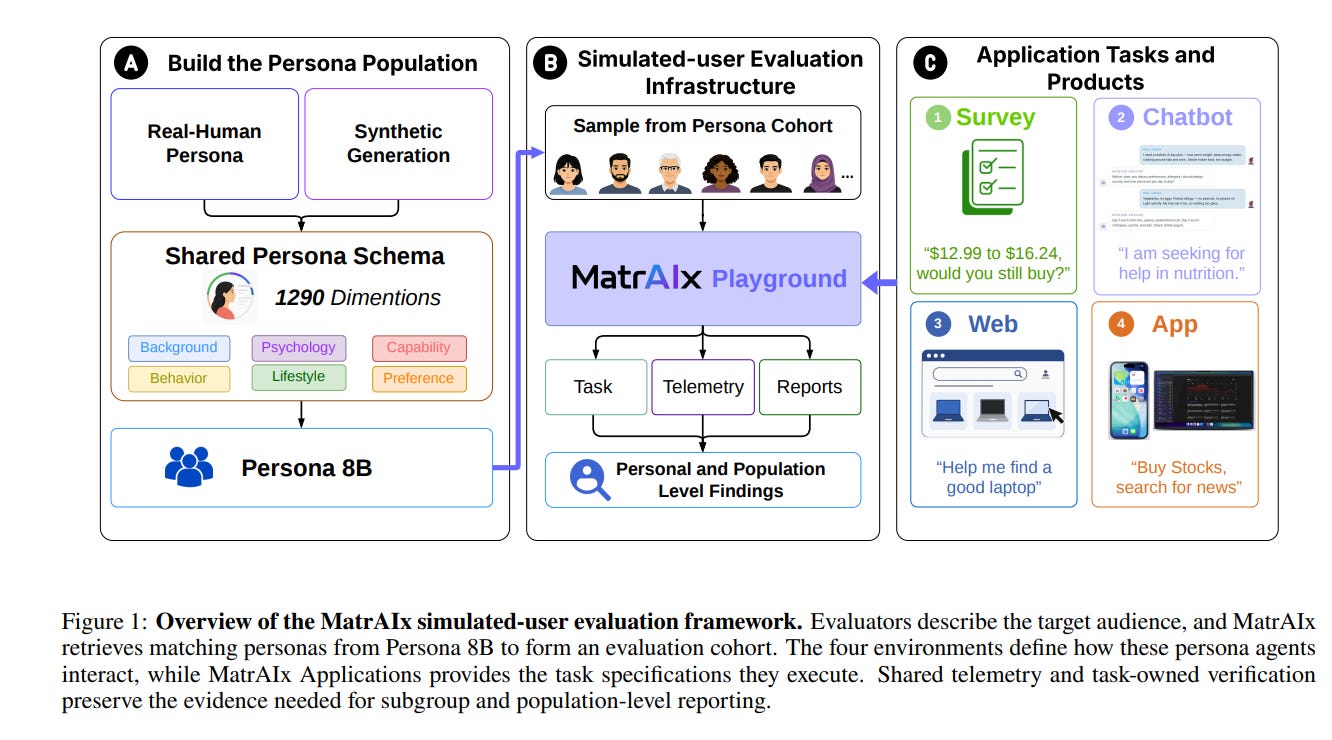
The paper’s core architecture is laid out in Figure 1 above, and it is surprisingly concrete. MatrAIx combines three pieces: a massive persona database called Persona 8B, a playground with four evaluation environments, and a library of reusable application tasks. The four environments matter because they move beyond static scoring. The system can run survey-style evaluations, chatbot conversations, web interactions, and app-based tasks, then record what persona agents say, do, and decide. That makes the project feel less like a benchmark leaderboard and more like infrastructure for pre-deployment product testing.
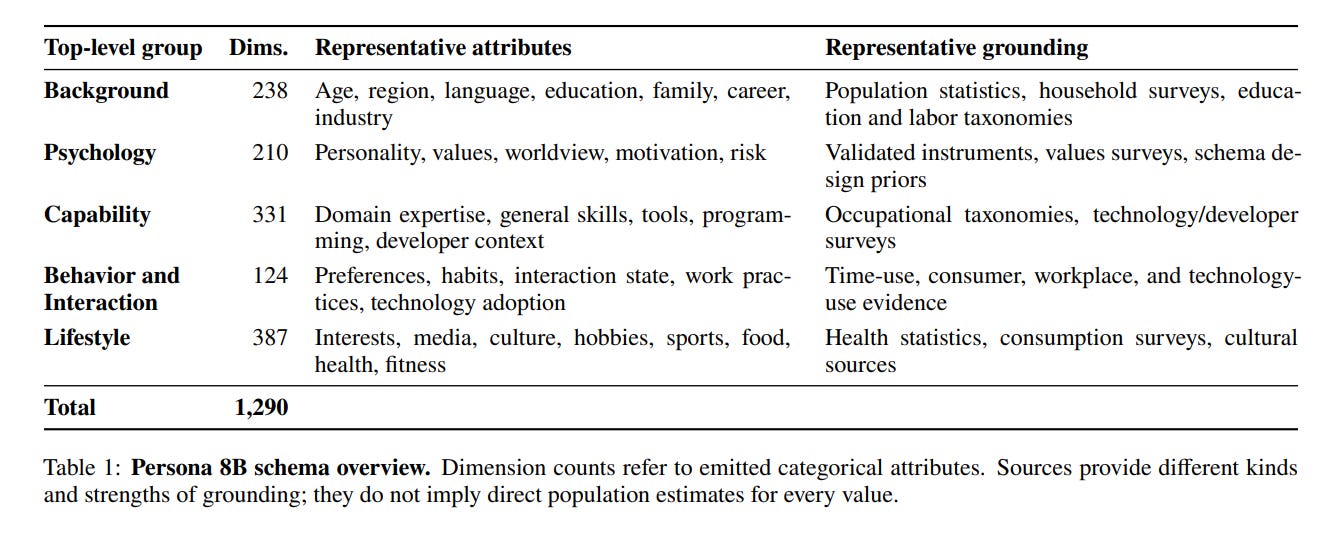
The database itself is where the authors make their biggest quantitative move. In Table 1, they summarize a schema with 1,290 categorical dimensions covering background, psychology, capability, behavior, lifestyle, and preferences. That is the important part, more than the headline number of 8.3 billion records. The paper is arguing that if you want simulated users to be useful, you need a typed and queryable representation of human variation, not just a pile of free-form biographies. A product team should be able to ask for cohorts defined by age, language, expertise, accessibility needs, or risk tolerance and then run the same task across those groups.
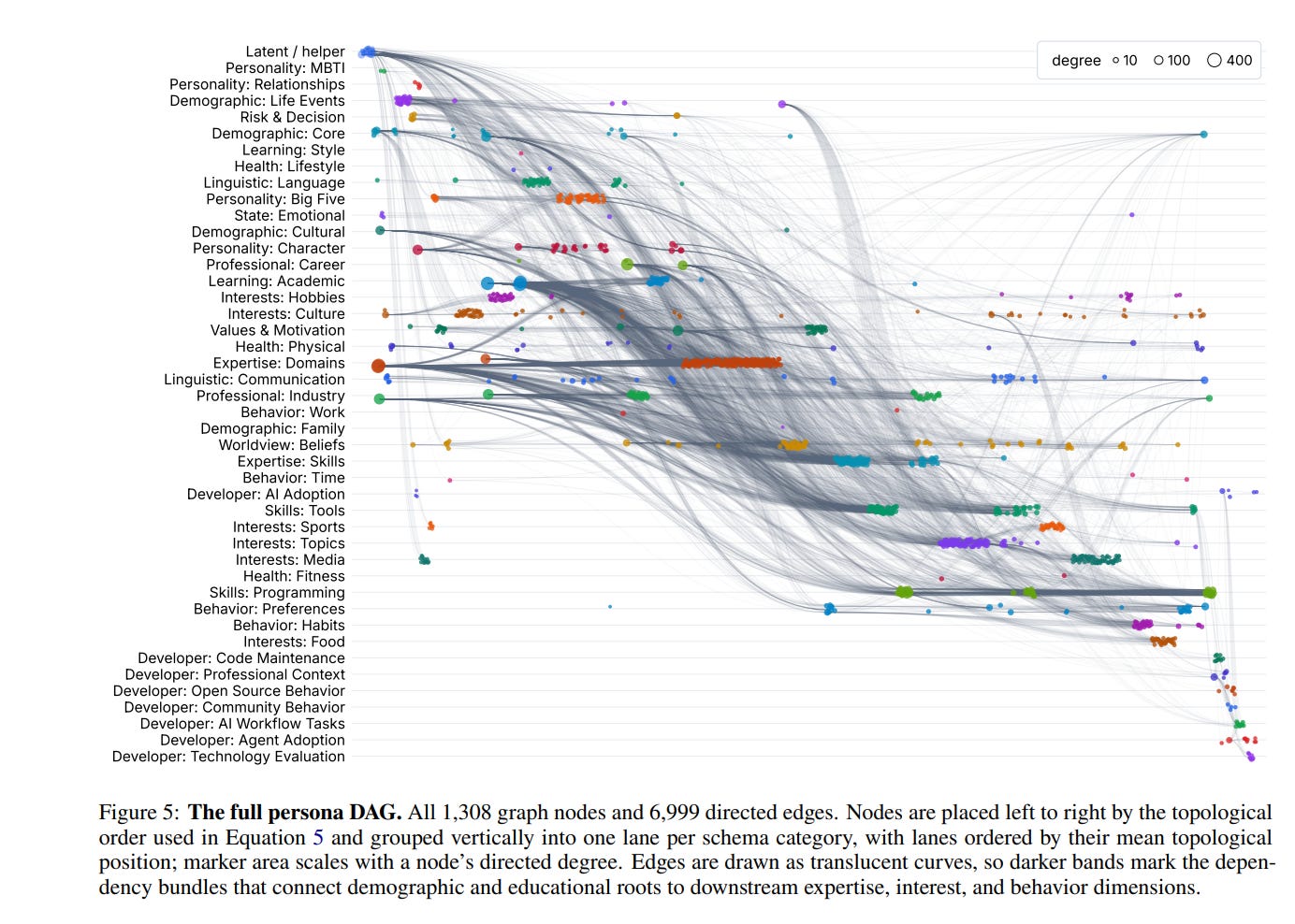
What keeps this from being just a giant spreadsheet is the sampling model behind it. The appendix-heavy but conceptually important Figure 5 shows the full persona dependency graph: 1,308 nodes and 6,999 directed edges, with 1,290 observable attributes plus a small number of latent roots. That sounds baroque, but the motivation is reasonable. If you sample every trait independently, you get incoherent people. The authors instead use a directed acyclic graph so that variables like education, language proficiency, employment history, and behavior are sampled conditionally rather than arbitrarily. In plain English, they are trying to preserve the difference between a diverse population and a random bag of mismatched traits.
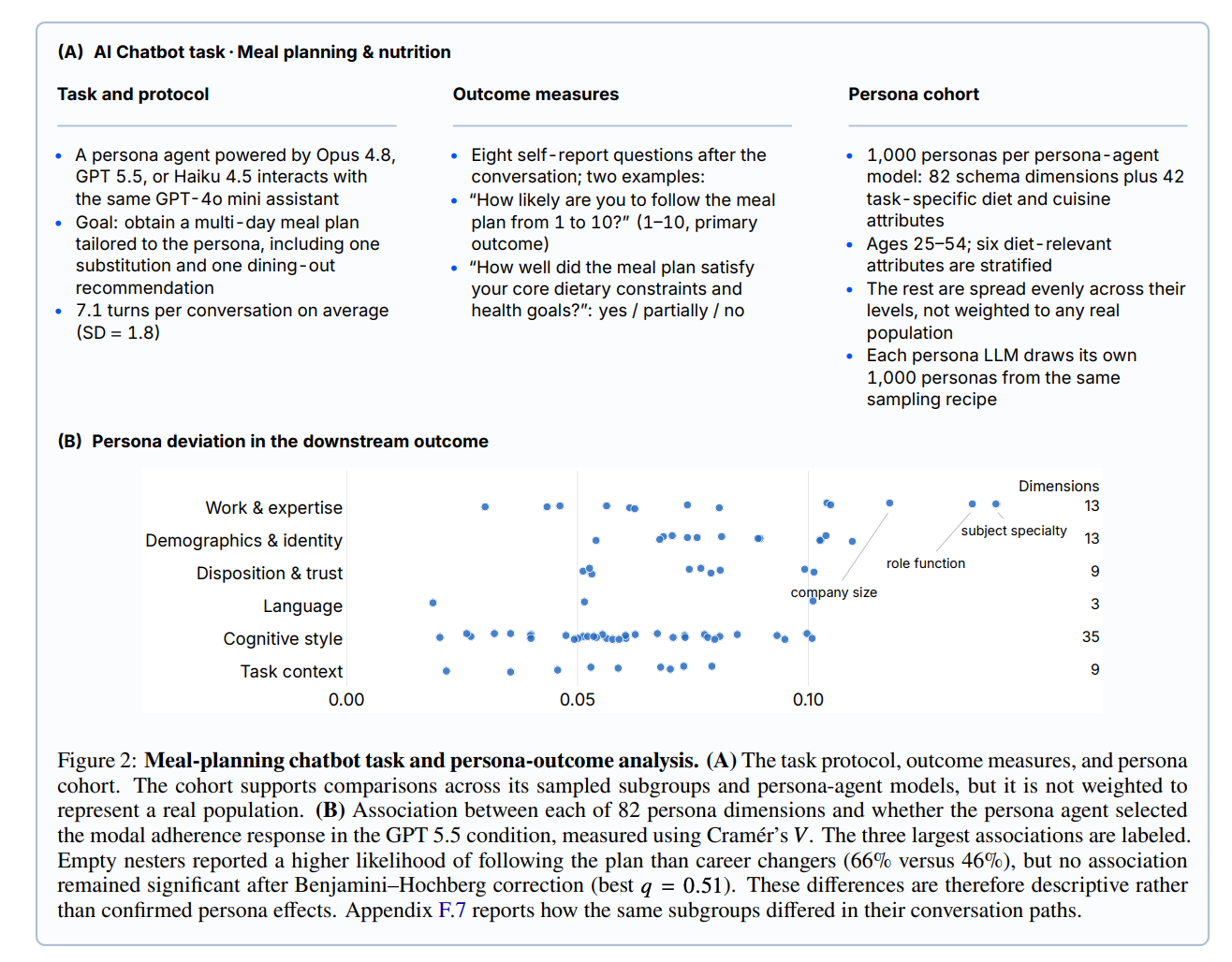
The most intuitive example of how the system is meant to be used appears in Figure 2, which follows a meal-planning chatbot study. Persona agents interact with the same assistant, and the authors then ask whether differences in downstream responses line up with differences in persona attributes. The result is interesting partly because it is restrained: some subgroup differences appear descriptively, but the paper notes that none remained significant after multiple-testing correction in that particular analysis. That is actually a healthy sign. It suggests the framework is not being presented as a magic machine that turns any demographic slice into a dramatic effect.
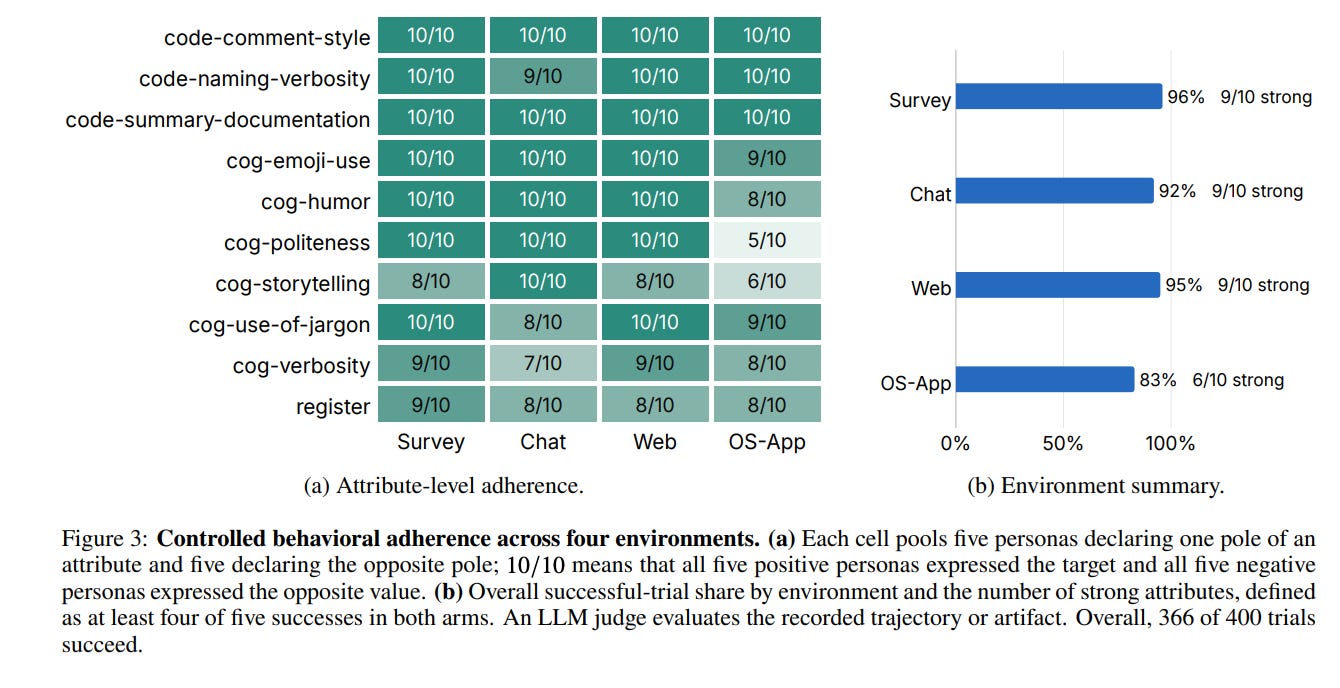
The stronger result is in Figure 3, which tests something more basic and arguably more important: do agents actually behave like the personas they were assigned? Across 400 trials spanning surveys, chat, web, and app environments, the system reports that assigned behaviors were expressed or correctly suppressed in 366 trials, or 91.5%. The environment breakdown is revealing. Survey, chatbot, and web settings look fairly strong, while app-based interaction is weaker. That is exactly the kind of result you would want to know before trusting this setup for consequential evaluation. It says the simulation framework is promising, but not equally reliable in every interface.
What I find most useful about the paper is not the scale claim but the evaluation philosophy underneath it. MatrAIx is designed to surface things aggregate benchmarks miss: hesitation after price changes, different tolerance for latency, varying willingness to continue after a failure, or different expectations of explanation and autonomy. Those are not edge details. For many AI products, they are the product. A system that technically completes a task but frustrates a specific user group is often failing in a way ordinary offline metrics will not capture.
There are still obvious reasons to be cautious. The authors themselves note that important findings should be checked across multiple persona-agent models and traced back to the underlying interactions. More fundamentally, simulated populations are not real populations. Even if the schema is thoughtful and the adherence numbers are good, there is still a gap between “this agent reflected a declared persona” and “this predicts what humans will do in deployment.” So the paper reads best not as a replacement for human studies, but as a screening layer before them.
The boldest claim here is not that we can simulate humanity. It is that we can build better tools for testing AI against heterogeneous users before reality delivers the harder verdict.