
EviGraph: Evidence-Guided Autonomous Research Agents
Another interesting work on autonomous science

Today’s paper: EviGraph: Evidence-Guided Autonomous Research Agents. Ren et al. 5 August 2026. https://arxiv.org/pdf/2608.04738
One of the big problems with autonomous research agents is that they can produce something that looks like science without actually maintaining a clean chain of reasoning underneath. A system can generate a hypothesis, run code, write up results, and still end up with claims that are only loosely connected to the evidence. That is the core issue behind today’s paper, which argues the bottleneck is not just model capability, but architecture.
The authors’ main idea is simple and useful: instead of treating research as a pipeline of stages, they treat it as a graph of linked scientific objects. In their setup, a problem leads to a gap, the gap motivates a hypothesis, the hypothesis is tested by an experiment, the experiment produces a finding, and the finding supports a claim. That sounds almost obvious in retrospect, but a lot of agent systems do not explicitly preserve those dependencies once the workflow gets going.
What makes the paper more interesting is that the graph is not just a bookkeeping layer. EviGraph uses it as the system’s operational state. If a hypothesis drifts away from the gap it was supposed to address, or if a final claim overstates what the experiment actually showed, the system is supposed to detect that mismatch, identify the earliest weak point, and regenerate the downstream pieces that depend on it. The goal is not merely to get to the end of the workflow, but to keep the workflow internally coherent while it unfolds.
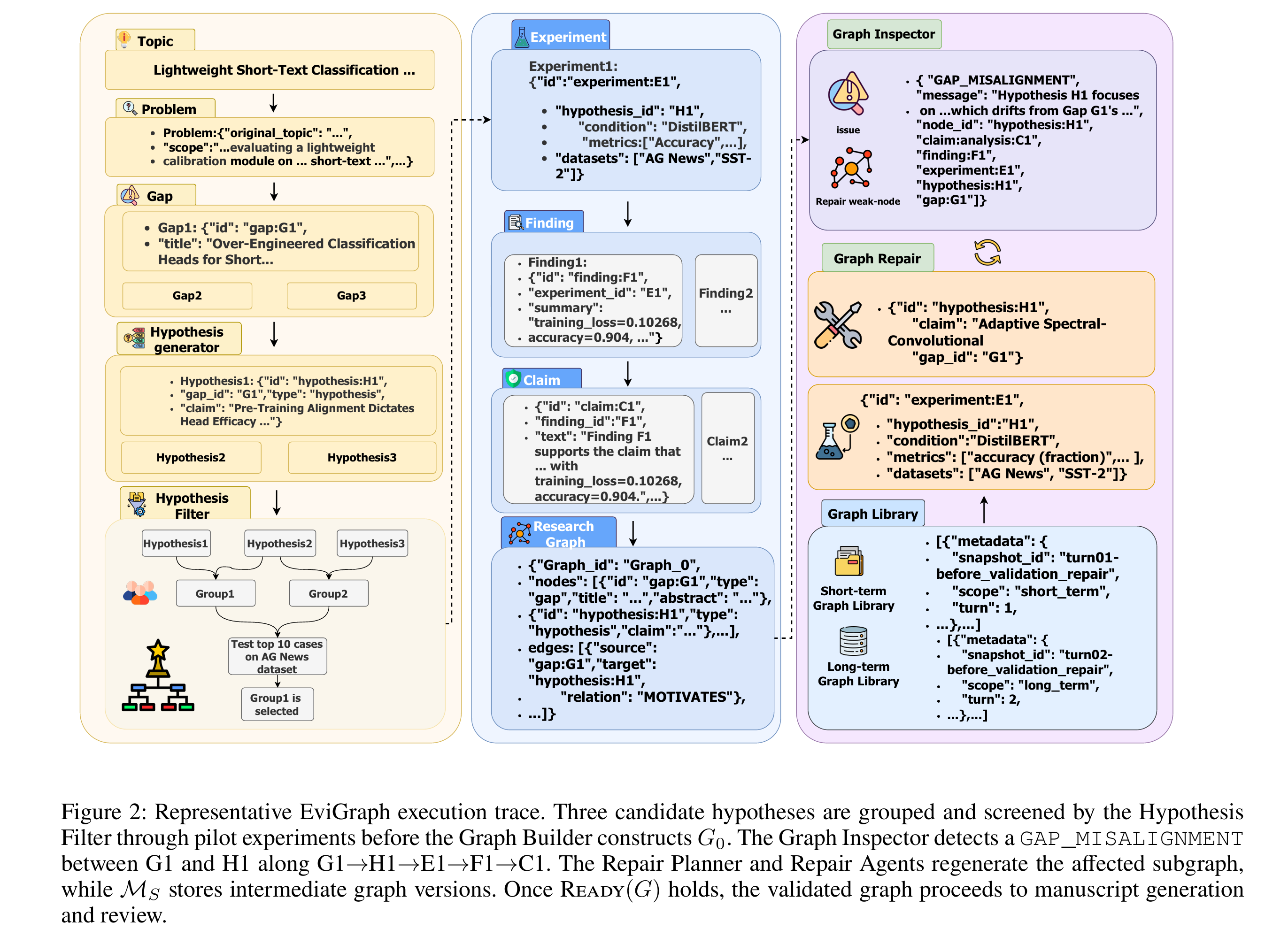
That logic shows up clearly in Figure 2 below, which walks through a representative execution trace. The system generates candidate hypotheses, groups them, runs pilot experiments, builds a provisional graph, and then catches a specific gap-hypothesis misalignment that would have been easy to miss in a standard pipeline. The important point is that the experiment had still run and the artifacts still existed; the issue was that the scientific story no longer lined up. EviGraph responds by repairing the affected subgraph rather than blindly accepting the finished-looking output.
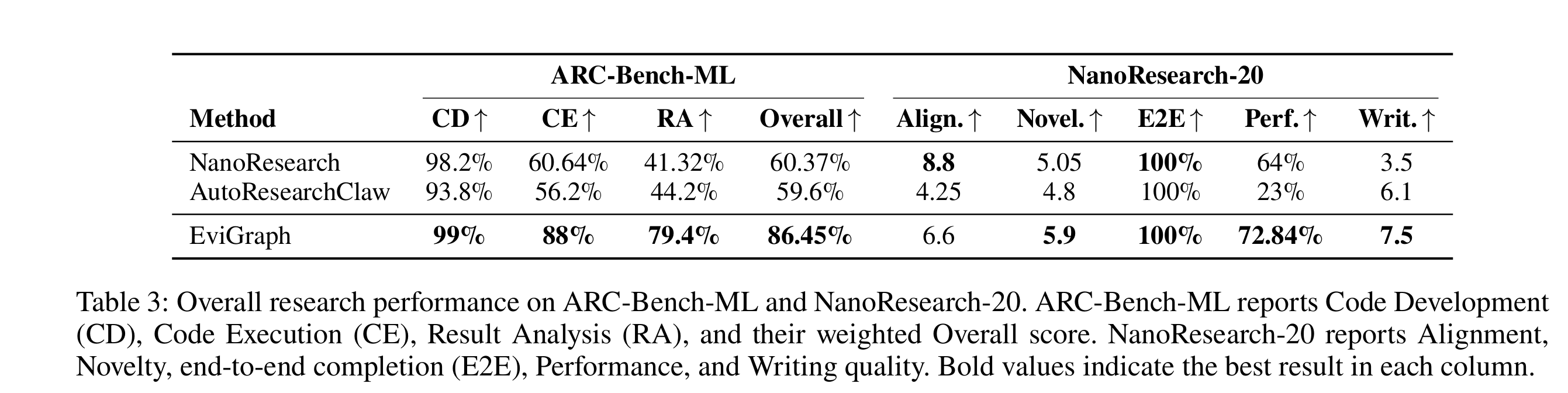
The headline quantitative results are in Table 3, and they are strong enough to take seriously. On ARC-Bench-ML, EviGraph posts an overall score of 86.45%, well ahead of the compared baselines around 60%. On NanoResearch-20, it leads on novelty, performance, and writing while matching the best end-to-end completion rate. The biggest jump is in result analysis, which fits the paper’s core thesis: if you explicitly manage the relationship between hypotheses, experiments, findings, and claims, you should expect the analysis layer to improve most.
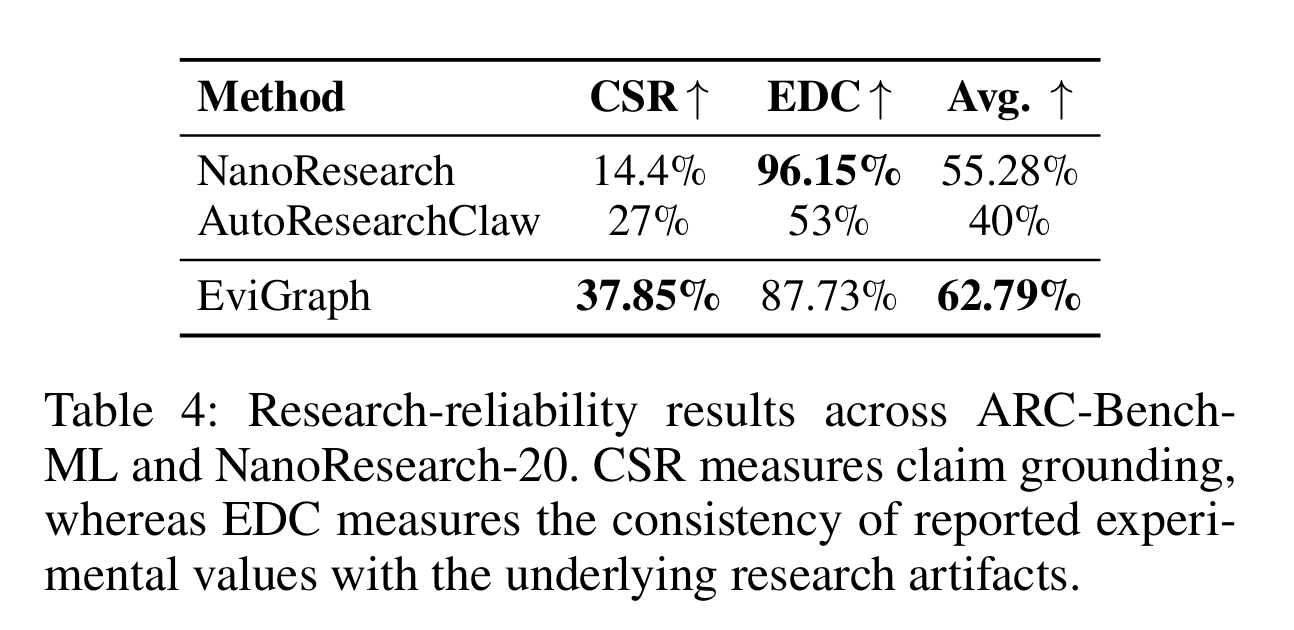
But the more revealing results are probably in Table 4, which focuses on reliability rather than raw task completion. EviGraph reaches a claim support rate of 37.85%, versus 27% for the strongest baseline, and an experimental data consistency score of 87.73%. Those numbers are not telling us that autonomous science is solved. They are telling us that many agent systems still struggle to ground their conclusions, and that a graph-based evidence model can make a noticeable difference.
There are still reasons to be cautious. The benchmarks here are limited, the reliability metrics rely on LLM-mediated claim extraction and judgment, and the paper’s own numbers show that even the improved system leaves a lot of unsupported territory. A 37.85% claim support rate is better than the alternatives, but it is also a reminder of how far these agents are from being trustworthy scientific collaborators. This feels less like a final solution than a good architectural correction.
Still, I think the paper points in the right direction. If AI research agents are going to matter, they probably need stronger internal representations of evidence, not just better prose and more tool use. We know that autonomous science is a hard problem, but we believe it’s well worth investing in. That’s why we’re building an AI research operating system at GRAIL to turbocharge scientific research with the latest tools. There’s much more to come in this space and we’re here for it.